


I had more time, but I was less fulfilled. What was I missing?
It’s been a year and some change since the United States (US) closed its borders due to COVID-19. What a whirlwind.
My wedding was planned for New York, not a week later. After frantically scrambling to find flights that would get me back in before the borders closed, I managed to catch a flight back to the US from South Africa for myself and one from Germany to the US for my fiancé.
We landed in Chicago on March 13th at 4 PM, 8 hours before the borders closed. And, of course, the courthouse was closed, so we had to track down an officiant from Indiana on Google who could marry us. We got married (socially distant, of course) in the pouring rain in the middle of the parking lot of the science museum.
Don’t tell me romance is dead.
COVID slowed everything down. I realized I had been “homeless” for the past four years. And unlike my childhood, it was company-sponsored; I was being paid for it. My job had me in a different country every few months. So, naturally, I lived out of hotels for four years straight. In fact, in 2019, I spent 300 nights in Marriott hotels and 35 nights sleeping on overnight flights. I was so busy, and I optimized my life to save 20 minutes anywhere I could. I carried only a backpack and a small carry-on to avoid waiting for a suitcase at baggage claim. I carried my entire life around in my hands. To save time. To achieve more. COVID changed all that.
Instead of moving to a new country every few months, I spent all of my time in the same place. All travel had stopped. I finally had leisure time, and yet I knew I was missing something. But what? What was I missing?
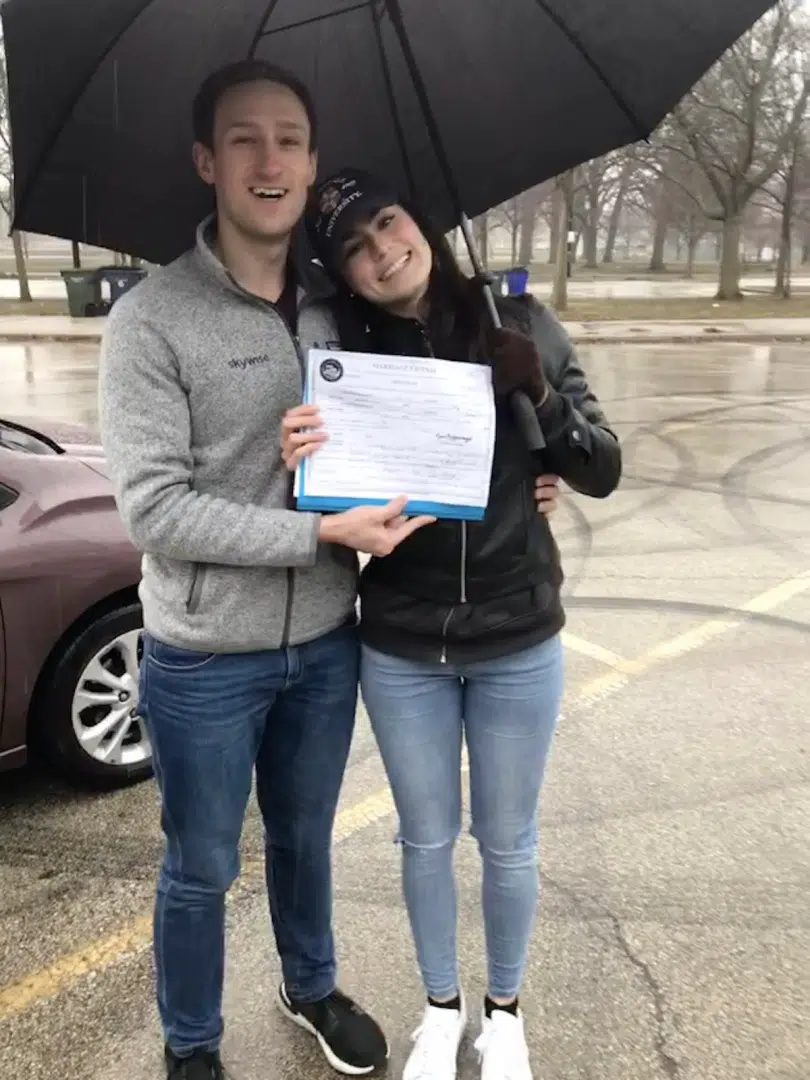
My wife, Catarina, and I holding our wedding licence. Chicago, IL.
Sixty years from now, the only person who will remember how many weekends I worked will be my spouse, not my boss.


I was pursuing my future to the exclusion of all else.
I have always been pursuing a better future for myself. At nine years old, I promised myself I would leave the confines of poverty and never return. So I threw myself into my work.
As a driving force of outcomes in my organization, I’d always felt powerful in this domain. Focus, getting things done, and grit – all traits that enabled me to accomplish the goals I set for myself. I reveled in my ability to produce. I felt successful. I believed that I utilized my time better than most everyone else. I thought I was winning. But I was wrong.
Working and traveling those four years, I internalized the wisdom handed down from the industrial revolution: productivity above all else; optimize your schedule for more output. I stripped all the unnecessary baggage out of my life: clothes, books, relationships. While I intentionally limited my wardrobe to 20 articles of clothing, I unintentionally failed to prioritize many friendships that I cherished.
Growing up in poverty, the financial anxieties I carried deep within me overpowered all else; I focused on being good at work, to the exclusion of all else. I spent those four years investing in my financial future, terrified of my financial past.
My partner was the shining light in my life for those four years. We had it pretty good: because I was traveling all the time for work, we had the opportunity to go on many trips we would never have been able to otherwise. Hardworking herself, she always supported me when I would prioritize work over enjoying the places we were. It didn’t matter if we were in Chile, China, or Brazil: I would spend all of my time working with our customers or working in my hotel room.
I should have been much more balanced. Sixty years from now, the only person who will remember how many weekends I worked will be my spouse, not my boss. So what do I do about it? How does one live a good life? I will spend the rest of my life answering this question. For now, I am focusing on what I call my “present filters”.
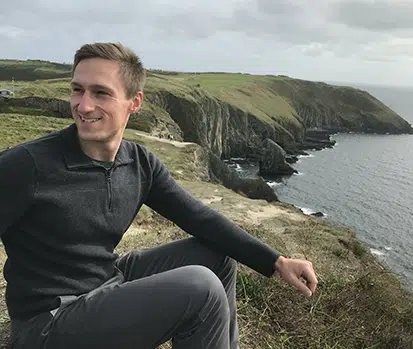
Nature is a great example of a space that gives me fulfilment and time.
Invest in the future, but don’t do so at the cost of every present. The only reason to invest in the future is to take advantage of the present that it will eventually become.
The future does not exist unless you let it.
I spent years building a future for myself. I played defense against a potentially harmful future. After COVID began, I started to realize the opportunity cost of working 100% of the time. I was neglecting time with the most essential thing in my life: my wife. I began to realize that the future only exists insofar as it exists when it becomes the present. Living too much of your life in the future is the cause of anxiety and is a surefire way to ruin the only thing we have: the present. So invest in the future, but don’t do so at the cost of every present you will ever have, because the only reason to invest in the future is to take advantage of the “present” that it will eventually become.
If I find myself anxious about the future, I consider this thought experiment: what am I afraid of happening? I am afraid of feeling sad, hungry, cold, hated and alone. But the future is uncertain and is nefariously tricky to predict. So the future I am afraid of may never come to pass. The only certainty is what happens when I let a negative future into my present: I guarantee the negative outcome of ruining the present because I am worried about a negative future. I am the reason that the imagined future becomes a reality. Gaining control over this future filter is one of my current most significant endeavors. It’s hard.
The same applies to those I love: if I work every day to provide a better future for my children, but they lose the ability to spend time with their father, am I serving them?
Some examples:
Am I enjoying the experience of planning a trip? If yes, that’s great – I’m enriching my present because I’m enjoying it.
Am I agonizing over a difficult decision and not making progress? If yes, then I need to decide and move on, or I need to schedule a date where I will be ready to make the decision and not let myself ruminate over a decision that I won’t make.
Am I making my present worse in an effort to improve my future?
Am I making the present of those I love worse in an effort to improve their future?
(A) and (B) above are the easiest to identify the correct course of action. (C) and (D) are the hardest to identify the correct course of action. For (C) and (D), I think about the “total life fulfillment” implication. If I spend all of my life enjoying the current and not investing in the future, then the present I experience in the future will be poor. If I spend all of my life investing in the future and never capitalizing on that future when it becomes the present, I rob every current self of their day. The same applies to those I love: if I work every day to provide a better future for my children, but they lose the ability to spend time with their father, am I serving them
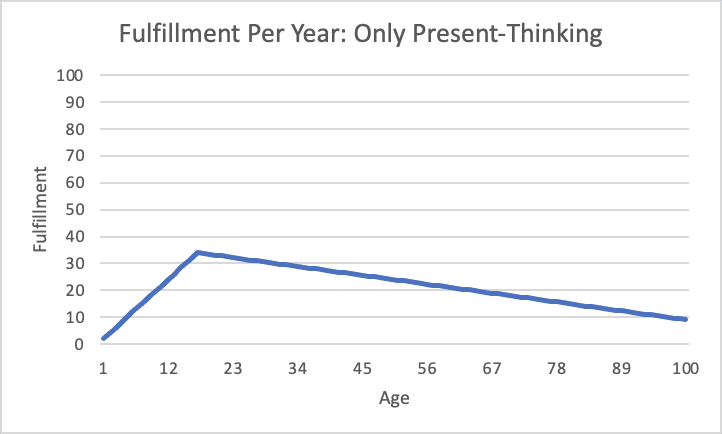
Living in the moment is common advice. But it ignores the fact that you have to prepare yourself to live in future moments as well. Ignoring your future entirely is not the solution because you will not maximize your “total life fulfillment” – the area under the fulfillment curve. But investing exclusively in the future is not the right strategy either.
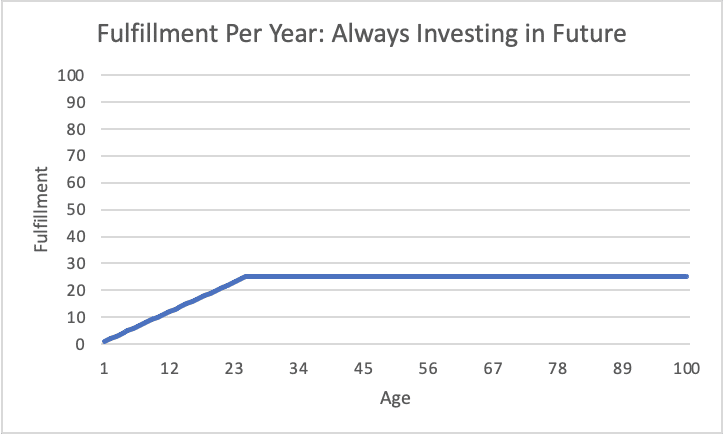
This is the trajectory that I was on for a long time: continuously investing in the future, rarely taking advantage of what each day could bring me. My present moments were not getting worse, but they were not getting better. The ideal is to fill your day with activities that you enjoy that will result in future achievement and present enjoyment.
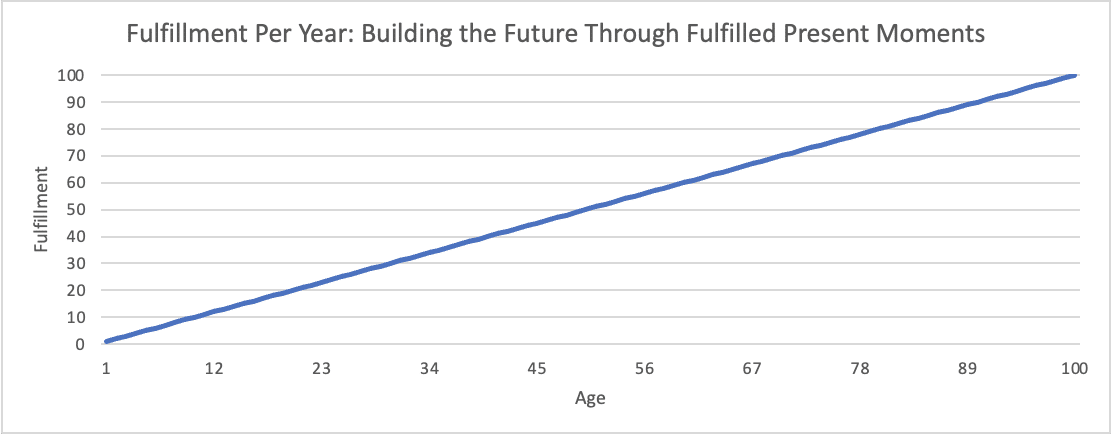
So live in the moment, but keep an eye towards the future.
Look for opportunities to do what you love, and figure out how to craft those activities into achievements. I expect to write on this in future letters because this in itself is pretty difficult. Ask yourself if your future-oriented thoughts and decisions will increase your total-life-fulfillment. I hope this framework enables you to be intentional with how the future makes its way into your life. I want you in control of your thoughts and lived experiences.
In the same vein, the past should only exist in service of the present and the future. I spend a lot of time thinking about the past. Sometimes, this is excellent. Sometimes, it is ruinous. In the same way I need a future filter, I need a past filter. That past filter should not permit my past into my present unless it’s in service of enjoying the present (e.g. through a lovely memory) or in service of improving the future (e.g. through intentional reflection). So reflect, but don’t ruminate. Again, gaining control over this past filter can be extremely difficult but well worth it.
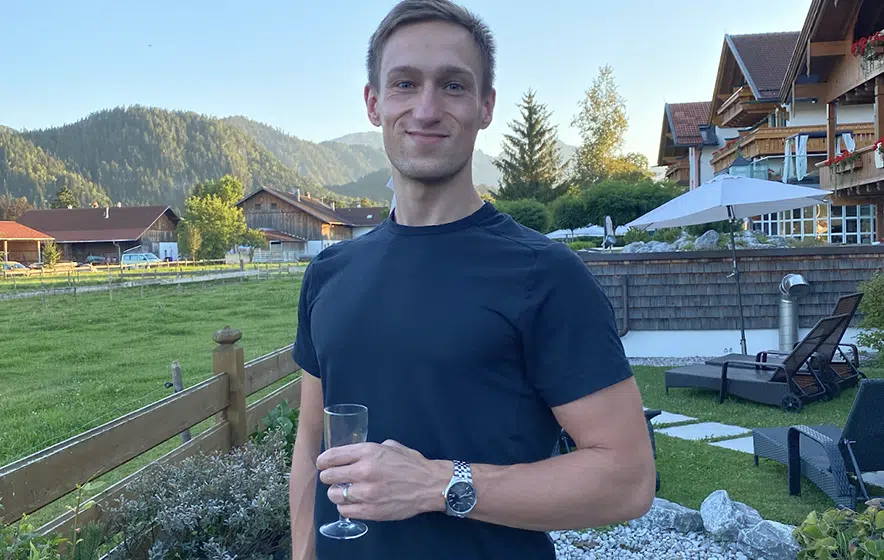
I hope to maximize my total life fulfilment by managing my time, but not how I once thought.
Before COVID, I tried to manage my time. I did this by optimizing for productivity, hoping to create a better future for myself and my family. I did not realize that I was sacrificing the only thing I had: the present. So now, when I think about managing my time, I think about managing my total fulfillment curve: will the sacrifice today generate a substantially better tomorrow? I expect my next letter will attempt to create a framework for how to answer that question / solve that problem. In the meantime, reach out if this resonated.